AlphaRail

AlphaRail

AlphaRail

AlphaRail

COMPUTIVE AI

Building the execution layer for wealth-management firms that run on compliance.

agency

Agilno

ROLE

Lead Product Designer

TEAM

Co-Founder - Strategy
Co-Founder - Product Development
Engineering team

timeline

2026

Deliverables

Brand, UX/UI, Front-end build

The Project

Acting with authority. 
Accountable for every action.

AlphaRail is an AI operator for Registered Investment Advisor (RIA) firms, the businesses that manage private clients' money and answer to a regulator for how they handle it.


Most of the software these firms buy flags the work and leaves the back office to finish it. Onboarding a client, transferring assets, updating a beneficiary and clearing a compliance review, each run across systems that were never built to work together, so completing them depends on someone remembering what happens next.

Permission before capability.

Our task was to develop a product that executes workflows end to end, with every step logged in a form that holds up to an audit.


The design problem was defining what an agent is allowed to do before deciding what it can do, and turning those limits into something an operations team can set in advance and act on in the moment.

DRAWING AND SHIPPING

Designing the brand and wiring the stack.

We built the identity from scratch, from the logo to its application across the site and later the platform. The setup went up in parallel, with the design file connected to the codebase through MCP and hosting ready to take it.

Four weeks from brief to deployment.

Taking on the front end removed the need for a handover. The build was verified against the designs, and revisions went straight to production.


The platform was still in development, so the site had to make the case without a product to point at.

Four weeks from brief to deployment.

Taking on the front end removed the need for a handover. The build was verified against the designs, and revisions went straight to production.


The platform was still in development, so the site had to make the case without a product to point at.

The site captures and qualifies interest, so our team can run each demo through a firm's own workflows, inside their compliance harness, against their actual use case.


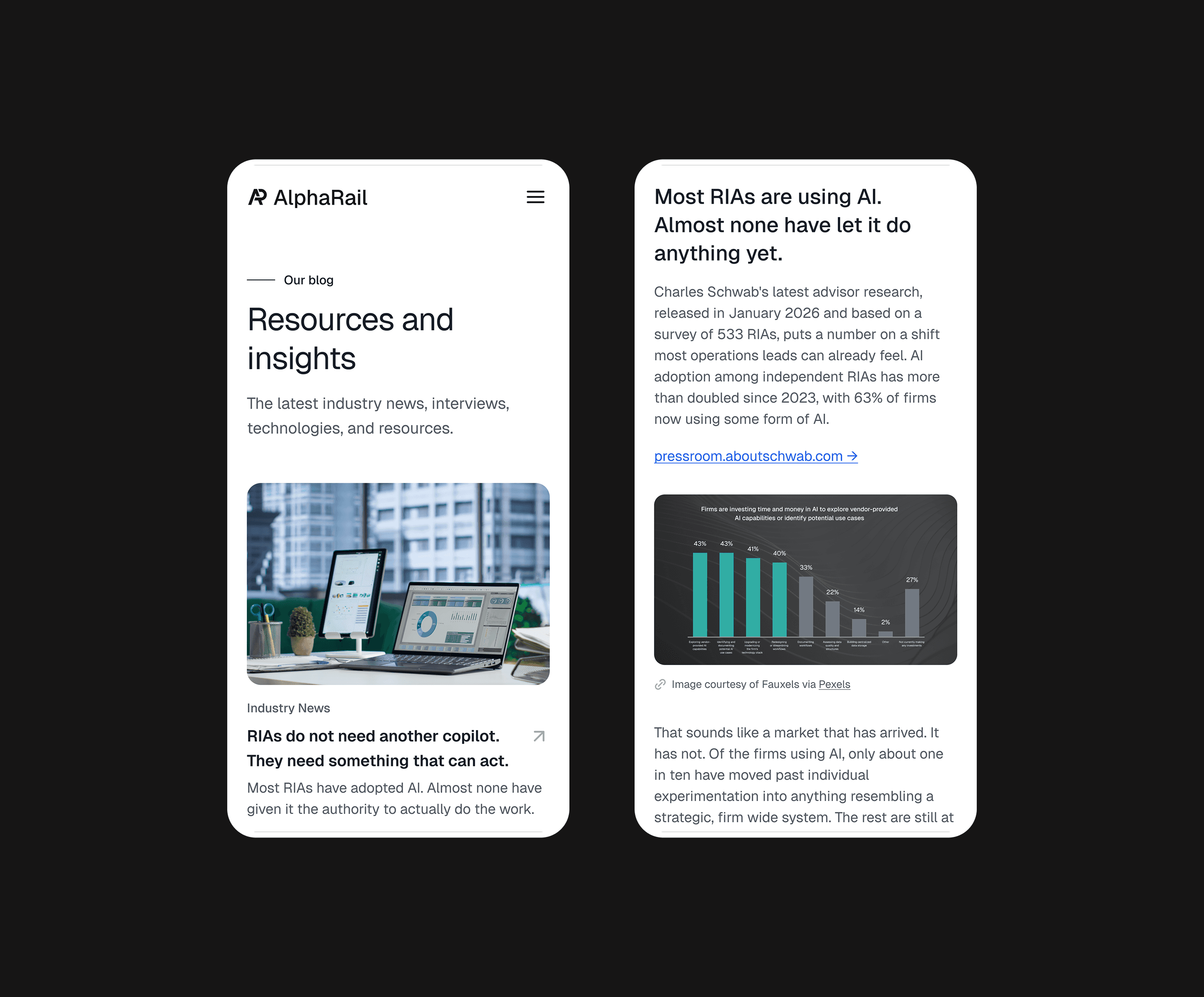
An industry blog followed, on a headless CMS of modular content blocks, so sales and marketing can publish and adapt posts as the product evolves.

INSIDE THE HARNESS

When autonomy is assumed, the controls become the product.

AlphaRail accelerates workflow completion across the CRM, custodians and document systems a firm already uses. Operations teams plug dedicated agents into existing processes, track which tasks are running, waiting or blocked, and gate any action that can't be undone. The record arrives audit-ready rather than assembled later.

INSIDE THE HARNESS

When autonomy is assumed, the controls become the product.

AlphaRail accelerates workflow completion across the CRM, custodians and document systems a firm already uses. Operations teams plug dedicated agents into existing processes, track which tasks are running, waiting or blocked, and gate any action that can't be undone. The record arrives audit-ready rather than assembled later.

Defining an agent down to the individual step.

To support a process that spans several systems and a dozen decision points, we created the agent builder as a canvas where every wait, timeout and escalation is set by the firm. 


The challenge sat in the modelling more than the layout, down to whether assets arriving as cash opened a conditional or fired a trigger of its own.

Defining an agent down to the individual step.

To support a process that spans several systems and a dozen decision points, we created the agent builder as a canvas where every wait, timeout and escalation is set by the firm. 


The challenge sat in the modelling more than the layout, down to whether assets arriving as cash opened a conditional or fired a trigger of its own.

Defining an agent down to the individual step.

To support a process that spans several systems and a dozen decision points, we created the agent builder as a canvas where every wait, timeout and escalation is set by the firm. 


The challenge sat in the modelling more than the layout, down to whether assets arriving as cash opened a conditional or fired a trigger of its own.

Guardrails the firm sets, on a floor it can't move.

Compliance cannot depend on configuration, so we split guardrails into two layers. The platform layer carries the regulatory limits and cannot be edited. The firm layer sits on top, where each firm adds its own policy.


That line between them is what lets a single product serve firms with very different appetites without anyone reaching the floor.

Guardrails the firm sets, on a floor it can't move.

Compliance cannot depend on configuration, so we split guardrails into two layers. The platform layer carries the regulatory limits and cannot be edited. The firm layer sits on top, where each firm adds its own policy.


That line between them is what lets a single product serve firms with very different appetites without anyone reaching the floor.

Guardrails the firm sets, on a floor it can't move.

Compliance cannot depend on configuration, so we split guardrails into two layers. The platform layer carries the regulatory limits and cannot be edited. The firm layer sits on top, where each firm adds its own policy.


That line between them is what lets a single product serve firms with very different appetites without anyone reaching the floor.

Where an agent must pause.

The gates sit where a firm's own process already requires a signature, at a custodian submission or a trades handoff. Each request carries the case and the guardrail behind it, and nothing moves until every approver has answered.

Where an agent must pause.

The gates sit where a firm's own process already requires a signature, at a custodian submission or a trades handoff. Each request carries the case and the guardrail behind it, and nothing moves until every approver has answered.

Where an agent must pause.

The gates sit where a firm's own process already requires a signature, at a custodian submission or a trades handoff. Each request carries the case and the guardrail behind it, and nothing moves until every approver has answered.

EARNING THE NEXT STEP

Capability arrives first.
Trust takes longer.

Nobody hands over the back office on day one. Wealth-management firms move client funds under a regulator's eye, so they start with one contained workflow and only extend its reach when the record holds.


How fast that happens is what decides whether an agentic product gets adopted.


An agent that acts is the easy part. Making the handover defensible is the design problem.

Menu