An agilno venture
Building the brand, app and launch for a smart planter that works with any plant, in any soil.
agency
Agilno
ROLE
Lead Designer
TEAM
Founder & Product Owner
Project Manager
Marketing & Creative
App Developer
External Ad Agency
timeline
2024 - 2025
Deliverables
Brand, UX/UI, Motion,
Campaign creative
The Project
A software company's first hardware bet.
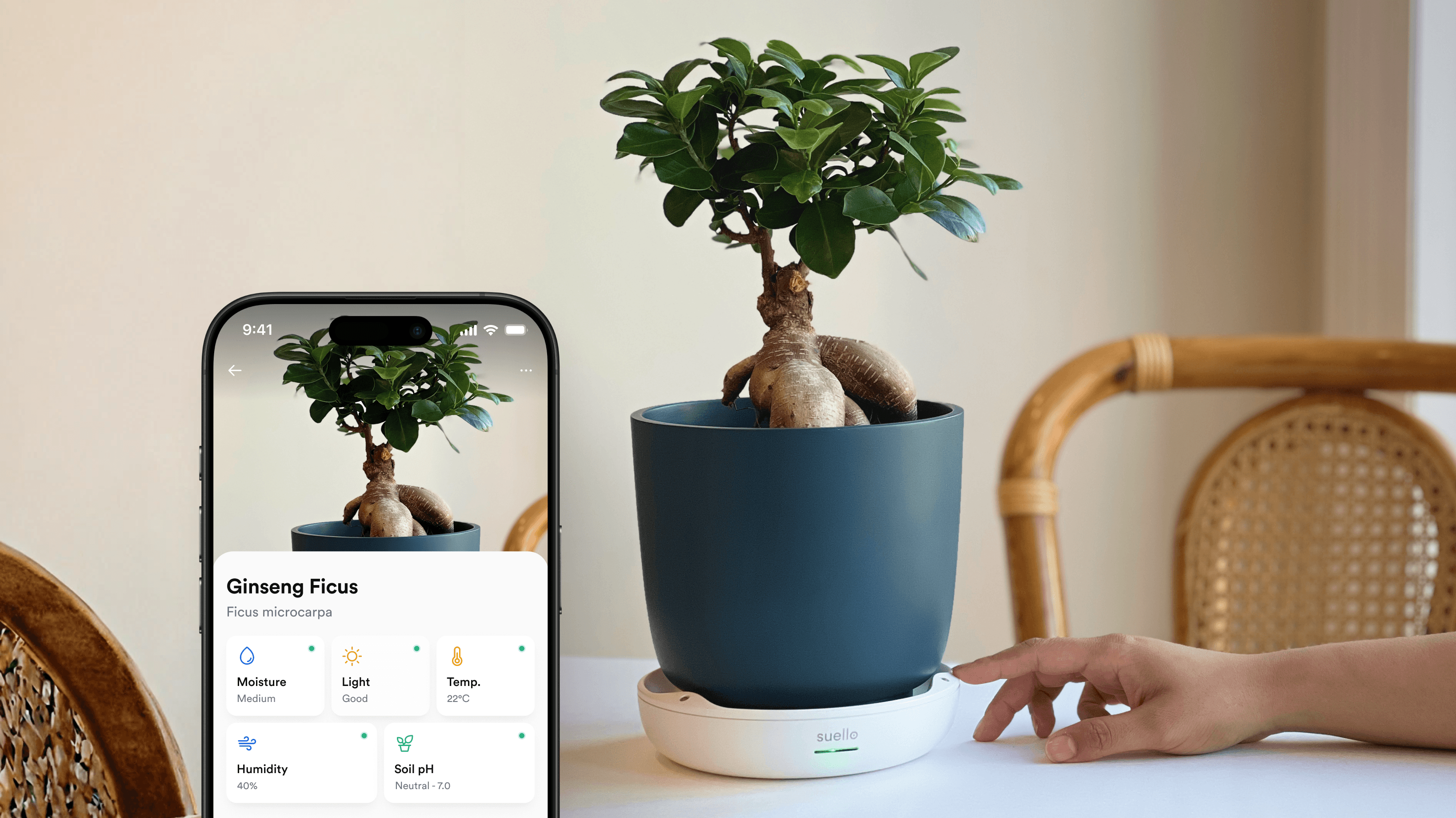
Suello is a planter with five sensors, tracking soil moisture, light, temperature, humidity and pH, pair with an app that turns those signals into clear, specific actions. It was the first thing Agilno had made for a shelf instead of a screen, and the studio's own venture.
The aim was to fund it on Kickstarter, with the planter as the first in a line of connected home devices.
The difficulty was one of sequence. The brand, the site, the app and the campaign all had to be designed before there was a planter to point at.
Taking the guesswork out of plant care.
A yellow leaf can mean drought, drowning, or the wrong window. By the time it shows, the cause is weeks old. Suello's premise was to read the cause, not the symptom.
FROM THE GROUND UP
Defining the brand. Where a smart planter belongs.
Suello arrived with no identity, no product to photograph, and a position spread over three sectors that share very little visually. Working directly with the founder, the brand was built from purpose outward.
The three principles shown pulled against each other. Innovation asked for something that read as technology, while harmony and mindfulness asked for an object calm enough to disappear into a room. The aesthetic work had to hold both at once.

The brand had to reach very different buyers.
The same identity had to work for early adopters, for people who want plants to thrive with less effort, and for anyone furnishing a home. The brand had to carry the technology without leading with it, which set a ceiling on how specialised it could afford to look.


Interest only survives if the product feels real, so the renders opened the planter up instead of dressing it. Something you can inspect is harder to doubt than something you are only shown.


THE LAUNCH
Producing a campaign on a weekly deadline.
The audience the model assumed was 25 to 45 years old, tech-comfortable and design-led, and the campaign's job was turning that into an email list ready to convert at launch.
An agency ran the paid media, and it needed fourteen weeks of new creative. That volume is why I set up a system, so every week hit all eight Meta ad angles and each concept shipped in three formats.


On reflection
What I'd want in place before starting again.
Lock the identity first.
Building a product, a site and a campaign on an identity still in motion cost us consistency and one clean story. Designing around it was right. But it was still the most expensive thing about the project.
Test the demand first.
Demand was assumed, not measured, and the plan was built on it. 14 weeks of media is a slow, expensive way to test an assumption. A short paid test up front would have cost a fraction of the campaign.