BioCirV

BioCirV

BioCirV

BioCirV

Beam Circular

Launching a public data portal to unlock the circular bioeconomy in California’s Central Valley.

agency

Agilno

ROLE

Lead Product Designer

TEAM

Project Manager
Engineering & Data Lead
Frontend Developer

timeline

4 months / 2026

Deliverables

UX/UI, Prototyping, Design system

The Project

A 5+ year initiative that needed a front door.

BEAM Circular is a hub for the circular bioeconomy in California’s agricultural heartland, one of the most productive farmland regions in the world and, inevitably, one of the biggest producers of organic waste.


They came to us to develop a digital platform that could inform and accelerate the commoditization of that biomass, supporting sustainable, bio-based production across the region.


Our challenge was to consolidate all available feedstock data, from composition and conversion to volumes and pricing, while presenting it clearly under one roof instead of scattered across spreadsheets and tools.

What shipped.

A public portal built around a whole region's biomass data. Researchers get credible, well-sourced data they can cite and compare; early-stage developers get the numbers to test whether a feedstock can support a real business.

THE CONSTRAINT

Three weeks from kickoff to a build-ready MVP.

We had less than a month to design a search-led landing page, a way to browse the growing biomass catalogue, and feedstock profiles carrying the conversion data researchers needed.

With engineering building almost as soon as design started, waiting for sign-off wasn't an option. I set up a component system designed for that pace, quick to adapt to feedback, so production could keep moving while designs were still in review.

Process

Planned early.
Weighed with engineering.

BEAM arrived with discovery already behind them. Before kickoff that research became user stories, an information architecture, and an MVP shaped to absorb the marketplace phase later.

Directions with a cost attached.

Rather than pitching a single solution, I brought different approaches for complex features, each worked through with engineering so it arrived with a real cost and timeline attached. That kept client conversations honest about what could ship now and what had to wait.

SCOPE

Designing beyond the brief.

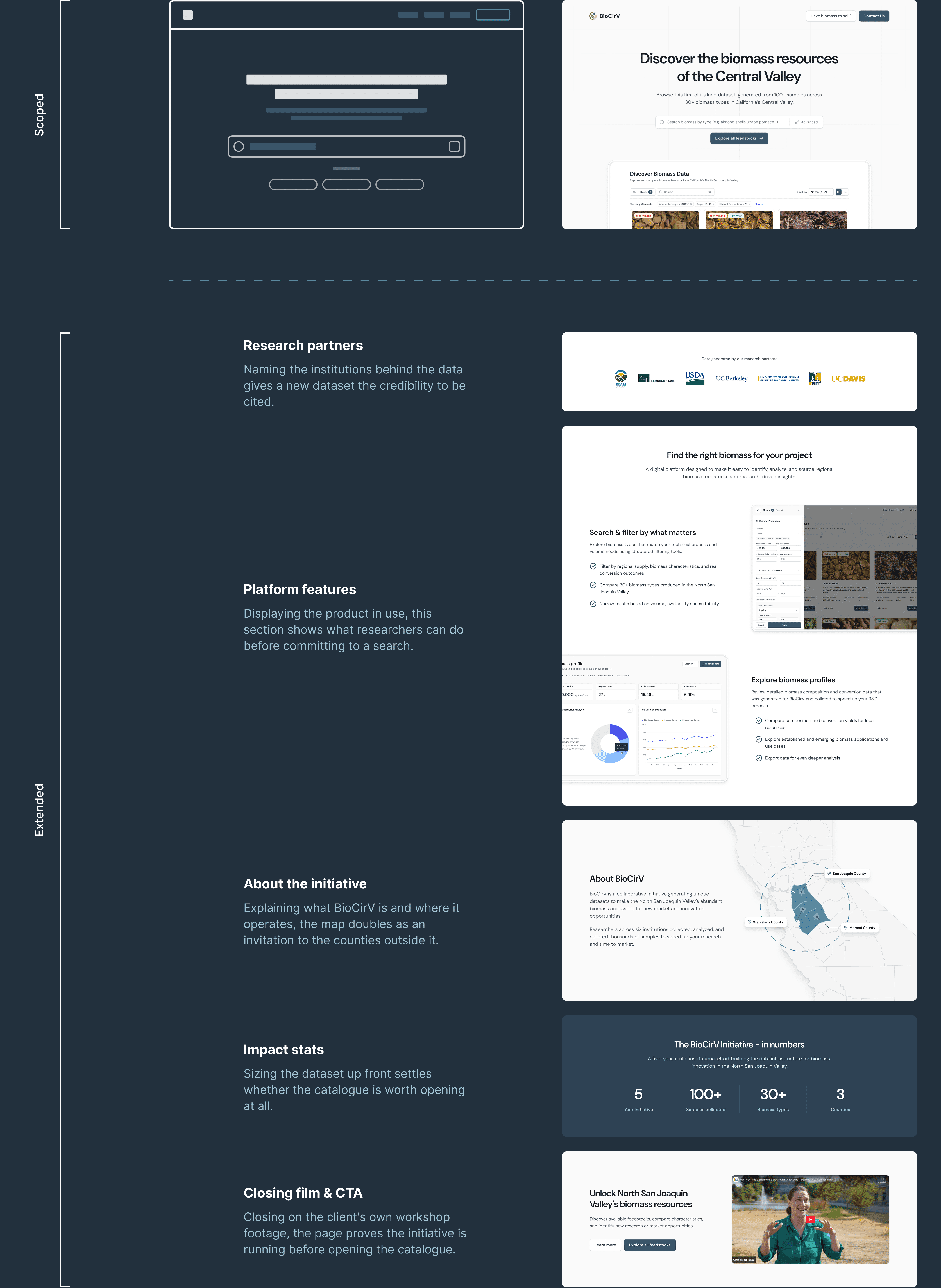
The brief scoped a search page. It would have worked, and it would have undersold the project. This was the public face of a multi-year initiative, with six research institutions behind the data and a marketplace ahead of it. So I expanded the landing page to match what it was fronting. Scope that wasn't costed in, but made its own case, and shipped in full.

SCOPE

Designing beyond the brief.

The brief scoped a search page. It would have worked, and it would have undersold the project. This was the public face of a multi-year initiative, with six research institutions behind the data and a marketplace ahead of it. So I expanded the landing page to match what it was fronting. Scope that wasn't costed in, but made its own case, and shipped in full.

THE PRODUCT

Five years of research from six institutions, in one platform.

THE PRODUCT

Five years of research from six institutions, in one platform.

One entry point,
two levels of expertise.

A researcher knows the feedstock they need. A newcomer doesn't yet have the words for it. One entry point serves both, and with the dataset still growing, keyword and filtered search stay separate so an early visit never ends on an empty page.

One entry point,
two levels of expertise.

A researcher knows the feedstock they need. A newcomer doesn't yet have the words for it. One entry point serves both, and with the dataset still growing, keyword and filtered search stay separate so an early visit never ends on an empty page.

Biomass that fits the process.

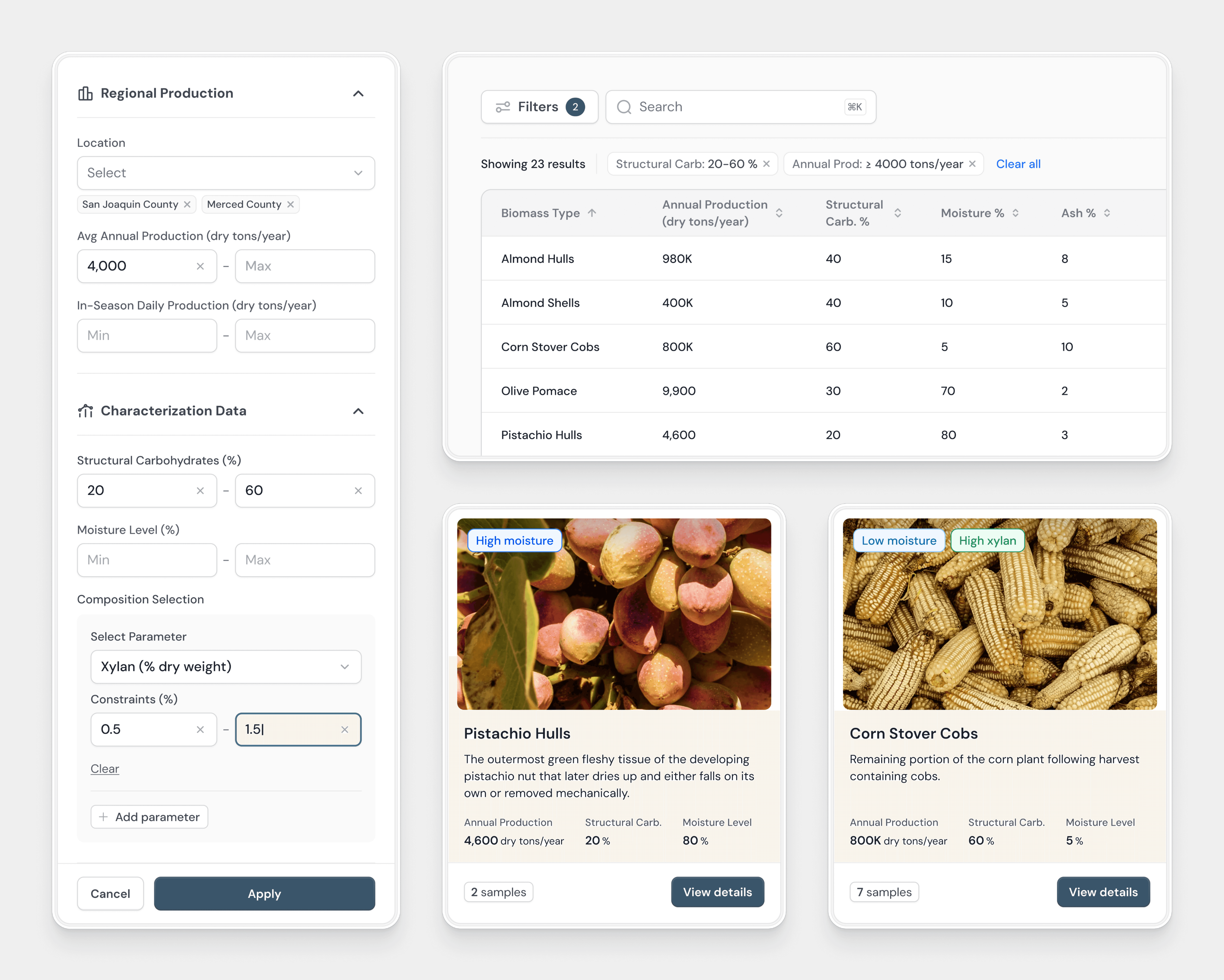
Filters cover regional supply, composition and real conversion outcomes, so a visitor can narrow the catalogue to feedstocks that match their technical process and volume needs.

Biomass that fits the process.

Filters cover regional supply, composition and real conversion outcomes, so a visitor can narrow the catalogue to feedstocks that match their technical process and volume needs.

Biomass that fits the process.

Filters cover regional supply, composition and real conversion outcomes, so a visitor can narrow the catalogue to feedstocks that match their technical process and volume needs.

Built for the combinations that don't exist yet.

Each profile carries composition, volumes, pricing and conversion performance across different treatments and enzymes, and those combinations multiply as more data arrives. Rather than design around the set in front of me, I built a comparison method that holds single or multiple pathways, and keeps working as the science expands.

Built for the combinations that don't exist yet.

Each profile carries composition, volumes, pricing and conversion performance across different treatments and enzymes, and those combinations multiply as more data arrives. Rather than design around the set in front of me, I built a comparison method that holds single or multiple pathways, and keeps working as the science expands.

Built for the combinations that don't exist yet.

Each profile carries composition, volumes, pricing and conversion performance across different treatments and enzymes, and those combinations multiply as more data arrives. Rather than design around the set in front of me, I built a comparison method that holds single or multiple pathways, and keeps working as the science expands.

BUILT TO SCALE

Three counties now,
eight by design.

The platform was scoped as infrastructure rather than a finished product. New counties enter without structural change, and a supply-side route shipped inside the MVP so supply and demand signals could start accumulating before the marketplace phase begins.

On reflection

Shipped on time, and
two lessons I took from it.

Data readiness.

We designed while the dataset was still being organised, so everything from filters to profiles had to stay flexible enough to absorb whatever came next. Settling what would exist at launch first would have made scope and timelines easier to hold.

The cost of moving in parallel.

Running design and build together was the right call for the timeline, and it wasn't free. Some work was rebuilt after revisions landed. The component system absorbed most of that, not all of it.

Menu